Vibration Isolation Case Studies
DAEIL SYSTEMS engineers active vibration isolation systems for the world's most demanding nanoscale imaging and metrology environments.
Series
Equipment Type
Manufacturer
All Case Studies
ETRI Attocube AttoDRY 2100 Cryostat DVIA-ULFB700 Installation Report
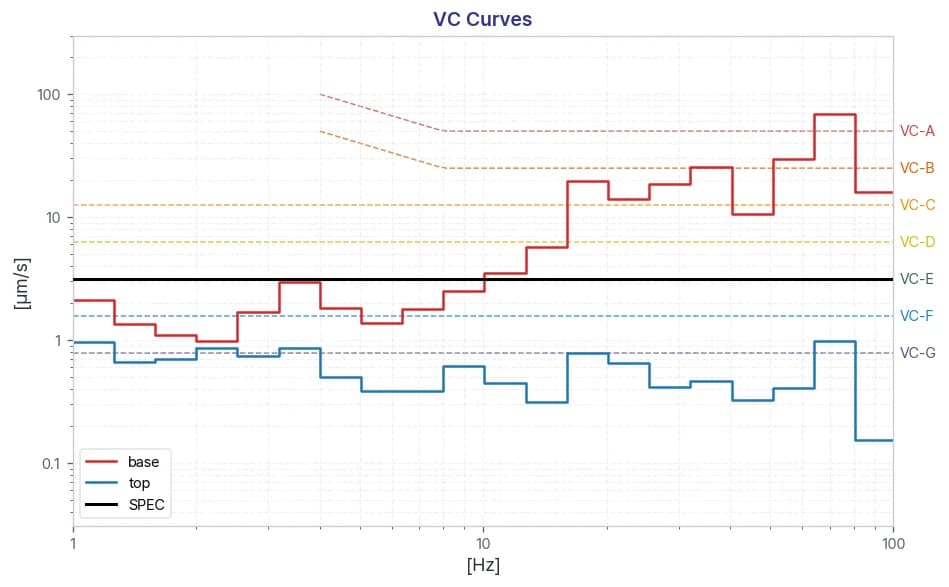
Installation report for the DVIA-ULFB700 vibration isolation platform (S/N 260707R4) supporting an Attocube AttoDRY 2100 cryostat in Room L02, Building 2 of the Electronics and Telecommunications Research Institute (ETRI). Tuning and vibration measurement were performed with the equipment in the IDLE state against a 3.125 µm/s RMS (VC-E) requirement in both the horizontal and vertical directions. On the floor all three axes failed the requirement, while on the isolated DVIA-ULFB700 platform all three axes passed: after the first round of tuning the vertical axis reached VC-F and the horizontal axes reached VC-E. Per-axis VC Curves for the Z, X and Y axes are published.
ZEISS Sigma 360 FE-SEM DVIA-ULF700 Installation Report
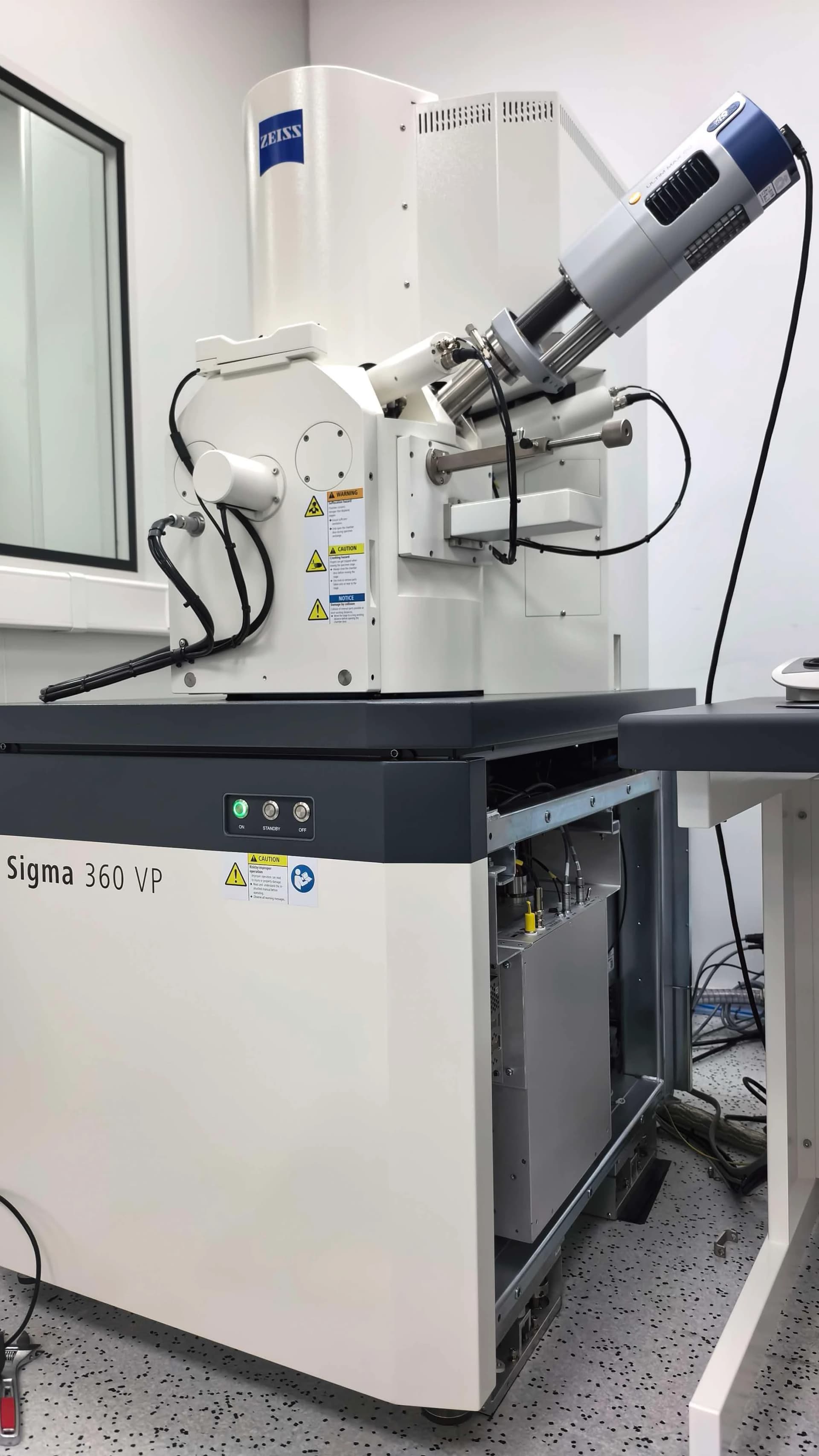
DVIA-ULF700 installation report (serial 260511R3) for a ZEISS Sigma 360 FE-SEM at End User Jiechuang Trading in Shanghai, China. Tuning was carried out on 2026.08.20 and vibration was measured with the equipment in the Idle state at two points, the installation floor and the top surface of the DVIA-ULF700. The floor failed the vertical criterion while both horizontal axes passed; on the DVIA-ULF700 all three axes (Vertical, Left to Right, Front to Back) satisfied the ZEISS specification, confirming that the isolator fully attenuates the vertical exceedance present in the site. Published figures: the tuning request work order, the per-axis Autospectrum traces captured from the UI program, and two installation photos.
Thermo Fisher Quattro ESEM DVIA-ML1000 Installation Report
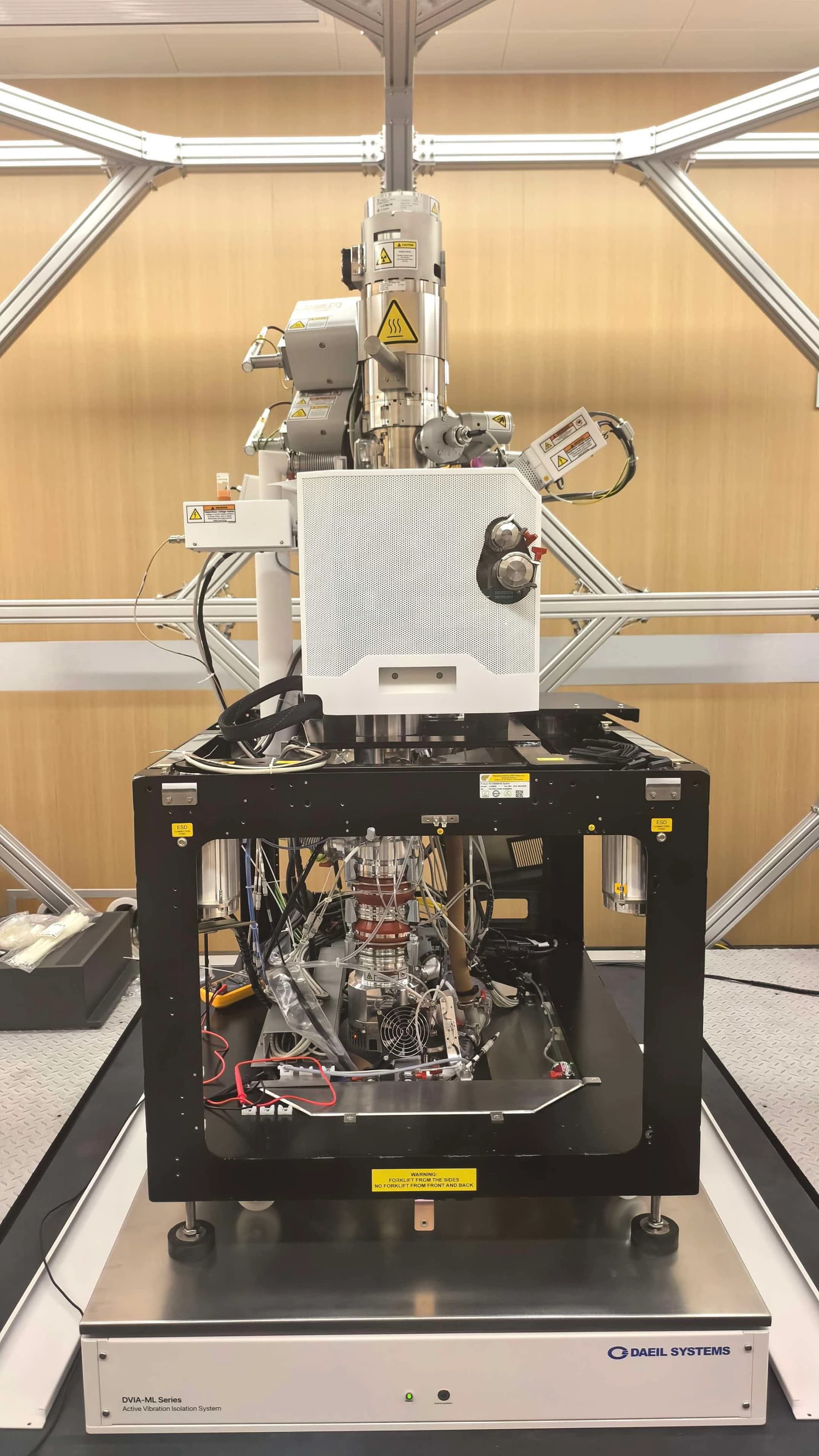
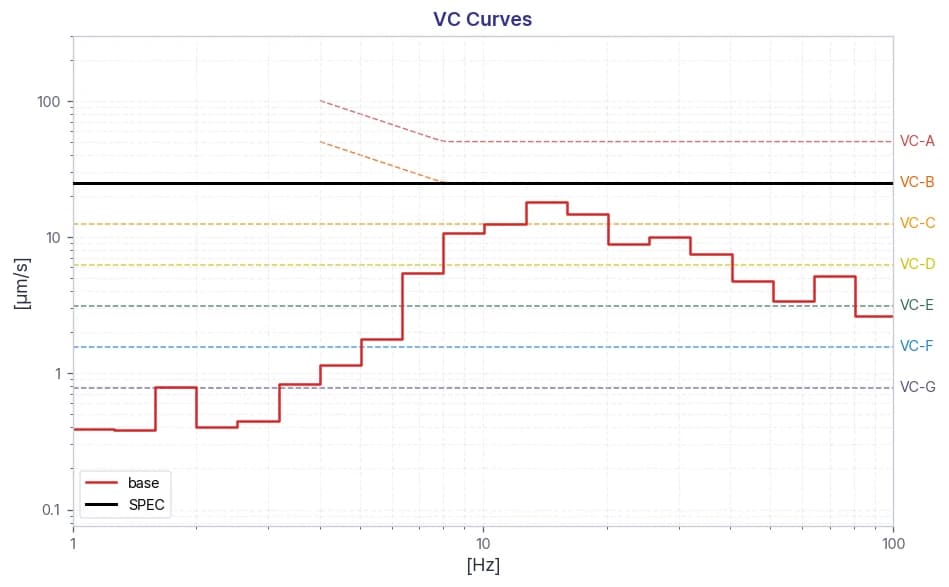
DVIA-ML1000 installation report (serial 260610R5) for a Thermo Fisher Scientific Quattro ESEM delivered through to End User Suzhou National Laboratory in Suzhou, China. Tuning was carried out on 2026.08.19 and vibration was measured with the equipment in the Turned off state, against a horizontal criterion of VC-G and a vertical criterion of VC-F. In the published VC Curve plots the floor (base) trace rises above the SPEC line on all three axes, while the trace measured on top of the DVIA-ML1000 stays below it across the whole 1–100 Hz band, showing that the platform brings the ambient environment of the laboratory down to the required VC class. Published figures: the tuning request work order, the per-axis VC Curve plots captured from the UI program, and the installation photo of the Quattro ESEM on the DVIA-ML1000.

Tier-1 Semiconductor Texas Advantest E5620 DVIA-P4000 Installation Report
Installation report for the DVIA-P4000 vibration isolation system, serial 260401R3-1, installed beneath an Advantest E5620 on the 3rd floor of the FAB at a Tier-1 Semiconductor site in Texas, USA. Work completed August 14, 2026. Scope covered rigging and positioning, lifting, setting the platform flush with the raised floor, levelling to within 0.5 mm, and attaching seismic restraints between the floor and the isolator, followed by vibration verification. The equipment manufacturer specifies VC-C (< 12.5 µm/s, 1-80 Hz) in all directions. Measurements were taken in three directions with calibrated seismic accelerometers at a 160 Hz bandwidth, and the DVIA-P4000 PASSED VC-C on Front-Back, Left-Right and Vertical. The allowable vibration specification and all three VC Curves are published.
FST LAZIN LODAS-B18 Photomask Blank Inspection System DVIF-FB (241001R5) Installation Report — Post-Reinforcement Performance Verification
Installation report for the DVIF-FB-1000x2000x3000H vibration isolation platform (S/N 241001R5) in the 3rd floor cleanroom of the FST Osan plant, covering the performance verification measurement carried out after reinforcement work on the platform top plate. A LAZIN LODAS-B18 photomask blank inspection system is mounted on top. Measurement was performed with the equipment in the IDLE state against a 25 µm/s RMS (VC-B) requirement in both the horizontal and vertical directions. Before reinforcement all three axes exceeded the requirement; afterwards the vertical (Z) axis improved from 27.7 to 17.9 µm/s and the left to right (X) axis from 70.7 to 22.4 µm/s, both satisfying VC-B, while the front to back (Y) axis improved from 71.0 to 48.0 µm/s (32.4% reduction) but remained at the VC-A level. Per-axis before/after VC Curves for the DVIF-FB top plate and per-axis VC Curves measured on the upper equipment stage are published.
Broadcast and Television Metrology Thermo Fisher Talos FIB-SEM DVIA-ML1000 Installation Report
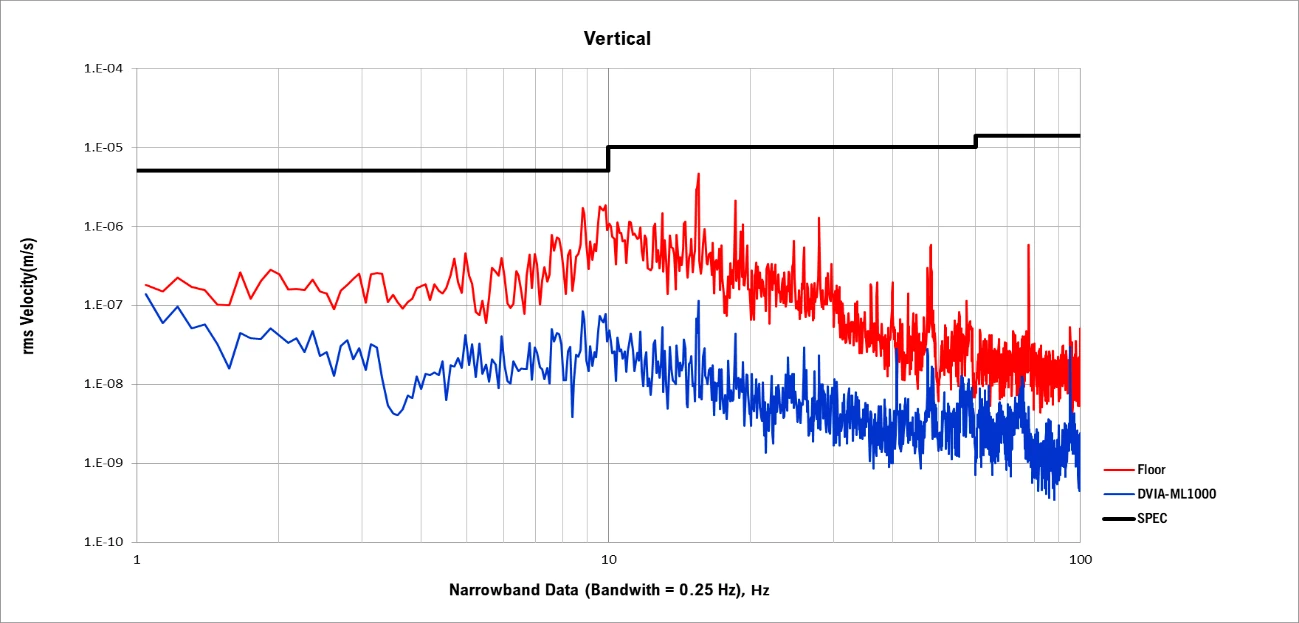
Thermo Fisher Scientific Talos FIB-SEM at Broadcast and Television Metrology in Wuxi, China, delivered through channel — DVIA-ML1000 installation report for the 1st tuning trial, tuned on June 5, 2026 with the equipment turned on/IDLE. Vertically the floor measured 4.62 µm/s RMS at 15.5 Hz while the DVIA-ML1000 platform stayed at 0.11 µm/s; left to right it went from 0.71 to 0.14 µm/s at 4.5 Hz and front to back from 0.58 to 0.034 µm/s at 3.5 Hz, so every axis passed on both the floor and the platform. Because Thermo Fisher Scientific issues site-specific ambient vibration requirements from its own SE-Tools site survey, the applicable specification follows that survey report. The tuning request work order and the per-axis VC Curves, Autospectrum and Transmissibility plots from the UI program are published.