DVIA-T
Tabletop Active Vibration Isolation System
Sub-Hertz Active Cancellation. Portable. Zero Compressed Air.
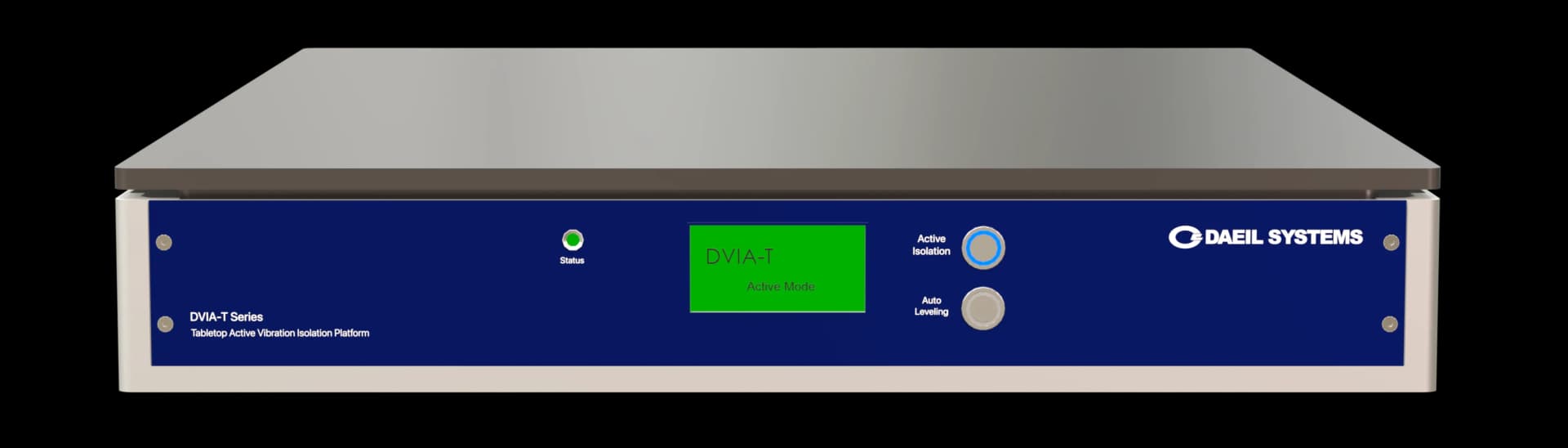
The DVIA-T brings 6-degree-of-freedom active vibration cancellation directly to your benchtop. Starting at 0.5 Hz. With absolutely zero compressed air. It's the ultimate foundation for nanoscale metrology. Plug it in. Tune out the world.
The world's highest performance.
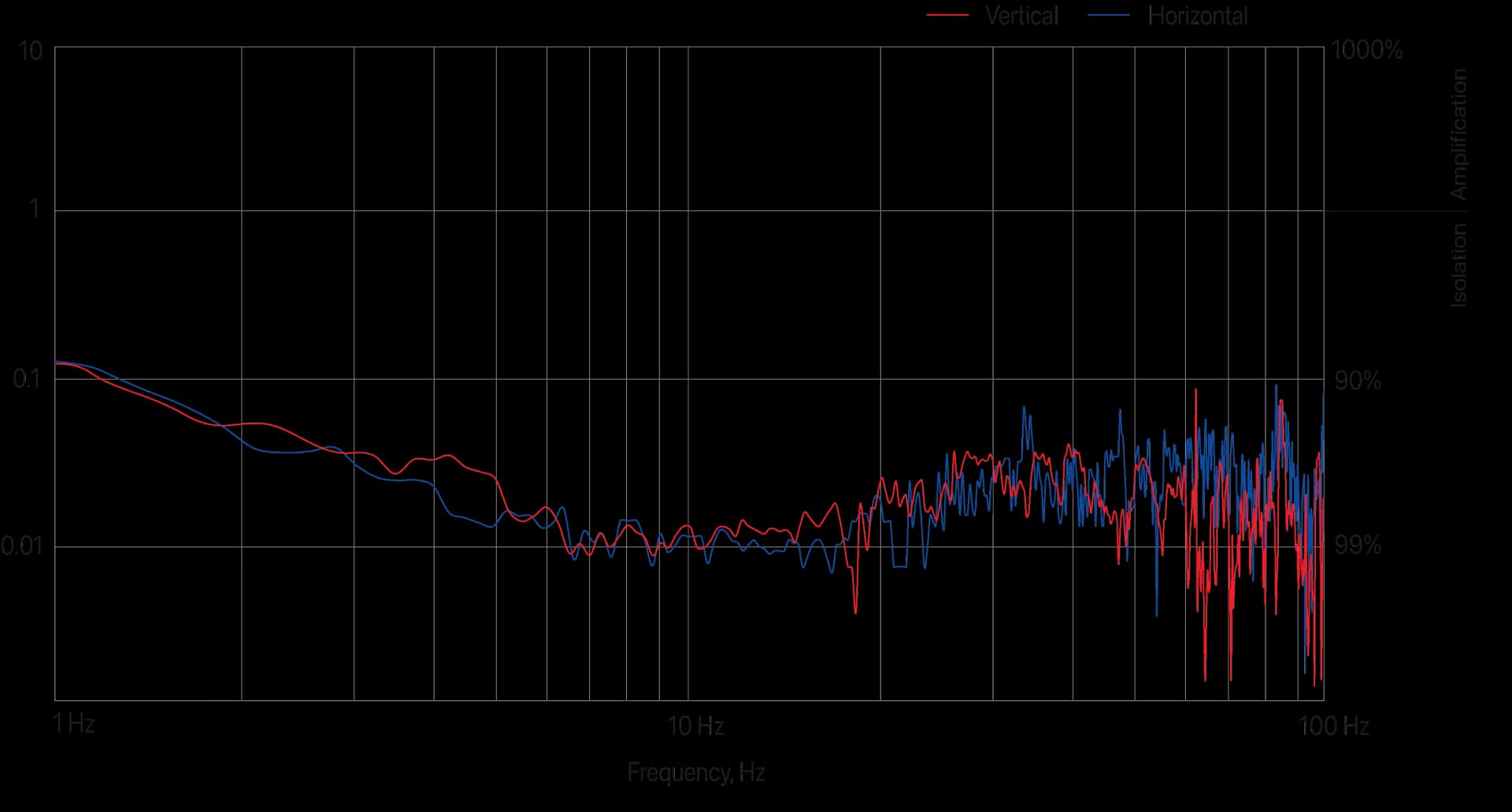
Passive air tables amplify low-frequency noise. Competing active systems struggle to keep up. The DVIA-T outperforms them all, delivering the most aggressive vibration cancellation profile on the market. Engineered with hyper-sensitive inertial velocity sensors and frictionless electromagnetic actuators, it doesn't just react to vibration. It dictates the environment faster than any platform in its class. The internal controller processes floor motion in real-time, instantly generating a precise counter-force to neutralize building sway before it ever reaches your instrument. The metrics prove the dominance. Active cancellation starts at an industry-leading 0.5 Hz. Isolation efficiency shatters the 90% threshold at just 2 Hz. Full 6-Degree-of-Freedom control guarantees absolute spatial stability.
True plug-and-play. Active isolation without the hassle.
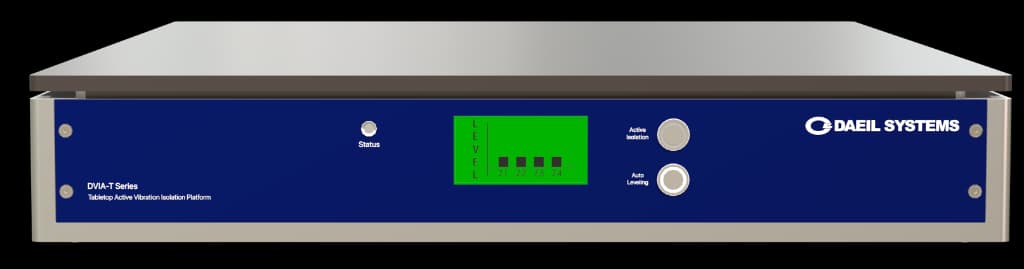
The DVIA-T delivers a true plug-and-play active isolation system engineered for absolute user autonomy. We designed the complexity completely out of the equation. Simply connect a standard AC power cable, position your instrument, and press two buttons: Auto-Leveling, then Active Isolation. With no pneumatic lines to route and no complex PID parameters to tweak, the onboard intelligent controller takes over instantly. It automatically maps your payload's mass and locks in the optimal active feedback loop. You secure a world-class, sub-hertz isolation foundation with zero installation downtime, achieving total environmental control in under five minutes.
Precise automatic leveling with ±0.08 mm repeatability
The platform utilizes an automatic leveling function to instantly establish precise structural alignment whenever a payload is placed or replaced. Delivering ±0.08 mm repeatability, this feature eliminates manual calibration during instrument changeovers, ensuring continuous workflow efficiency and immediate operational readiness.
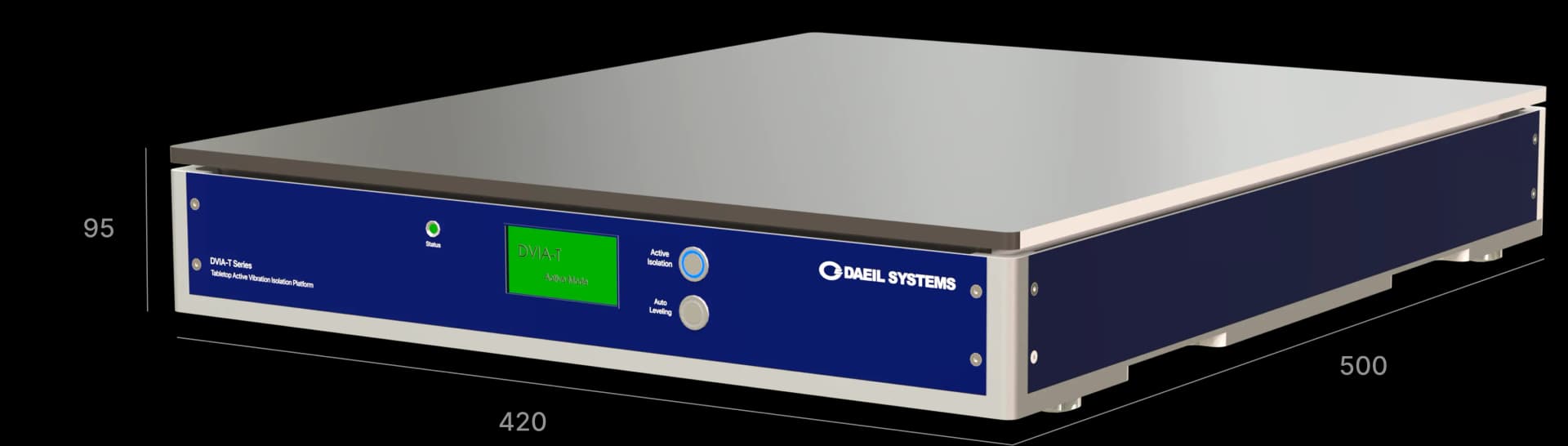
Compact & Portable: 420 × 500 × 93 mm
The DVIA-T delivers advanced active vibration isolation in a 25 kg tabletop design. It is fully plug-and-play. Simply place it on a standard bench, connect it to power, and it immediately establishes a stable foundation for your instruments—no compressed air or complex installation required.
User Interface for precision analytics
The DVIA-T series features a dedicated user interface. Users can monitor real-time vibration, actuator, and sensor data, log system parameters, and analyze performance metrics
Transmissibility
Auto-Spectrum
VC curves
Actuators, Sensors
Feedback corrects. Feedforward anticipates.
Feedback measures vibration on the isolated mass and counters it in real time. Feedforward reads the floor and cancels disturbances before they arrive. Together, they deliver exceptional low-frequency isolation. Your instruments operate as if the vibration doesn't exist.
 How it works
Passive Isolation (Spring & Damper):
Without active controls, the spring (k) and damper try to absorb shocks. However, at low frequencies, they can actually amplify the floor disturbance (d), causing the mass to resonate.
Feedforward Control:
Leverages ground sensor data to proactively command the actuators, nullifying floor vibrations before they reach the isolated mass.
Feedback Control:
Continuously measures the isolated mass's residual vibration (y) and uses the actuators to counteract it in real time.
Together, these advanced control mechanisms significantly enhance isolation performance, keeping the mass nearly perfectly still!
System Controls
Toggle to observe how feedback and feedforward mechanisms counteract low-frequency floor vibrations.
Technical Specifications
DVIA-T45 Specifications
- Dimensions (W* × D* × H)
- 420 x 500 x 93 mm
- Payload Capacity Options
- 90 / 150 / 250 kg
- Vibration Isolation Technology
- Feedback and Feedforward Control
- Degrees of Freedom
- 6 DOF
- Active Isolation Bandwidth
- 0.5 - 200 Hz
- Vibration Isolation Performance
- 80 – 90% at 1 Hz, 90 – 99% at 2 Hz
- Actuator
- Electromagnetic Actuator
- Maximum Actuator Force
- Vertical: 12 N, Horizontal: 12 N
- Vibration Sensor
- Velocity, Sensitivity: 100.4 V/m/s ± 10%
- Response Time
- < 0.5 ms
- Leveling Repeatability
- ±0.08 mm
- Magnetic Field
- < 0.05 µT
- User Interface
- Real-Time Monitoring and Data Logging
- Controller
- Built-in
- Compliance / Certifications
- CE, TÜV
- Utility Requirements
- 100-240 V AC, 50/60 Hz, 72 W, 1.0 A
- Environmental Requirements
- Operating Temperature: 5-50 °C, Relative Humidity: 20-90%
DVIA-T Case Studies
Proven in the field. Installed in the world's most advanced semiconductor, aerospace, and research facilities.
Every system measured and verified on-site.
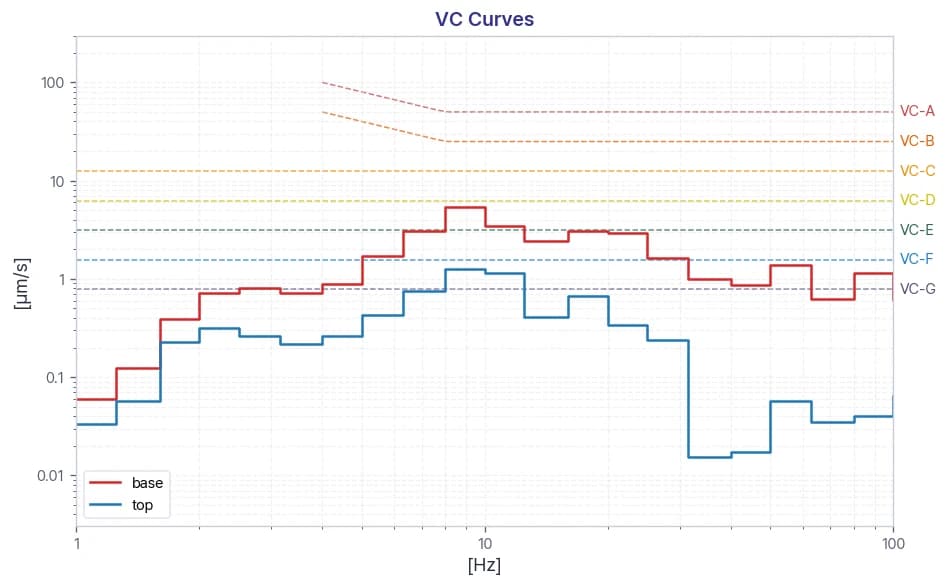
Pharrics BV MPI Corporation Probe Station MPI TS150 DVIA-T67 (260402R1) Installation Report
Installation report for the DVIA-T67 (serial 260402R1) installed for Pharrics BV in Leuven under an MPI Corporation MPI TS150 probe station. With no vibration specification defined, tuning and vibration measurements were performed with the probe station mounted on the system in the idle state. The results are presented as per-axis Autospectrum and VC Curve plots together with the IEST-RP-CC012.2 vibration criteria reference.
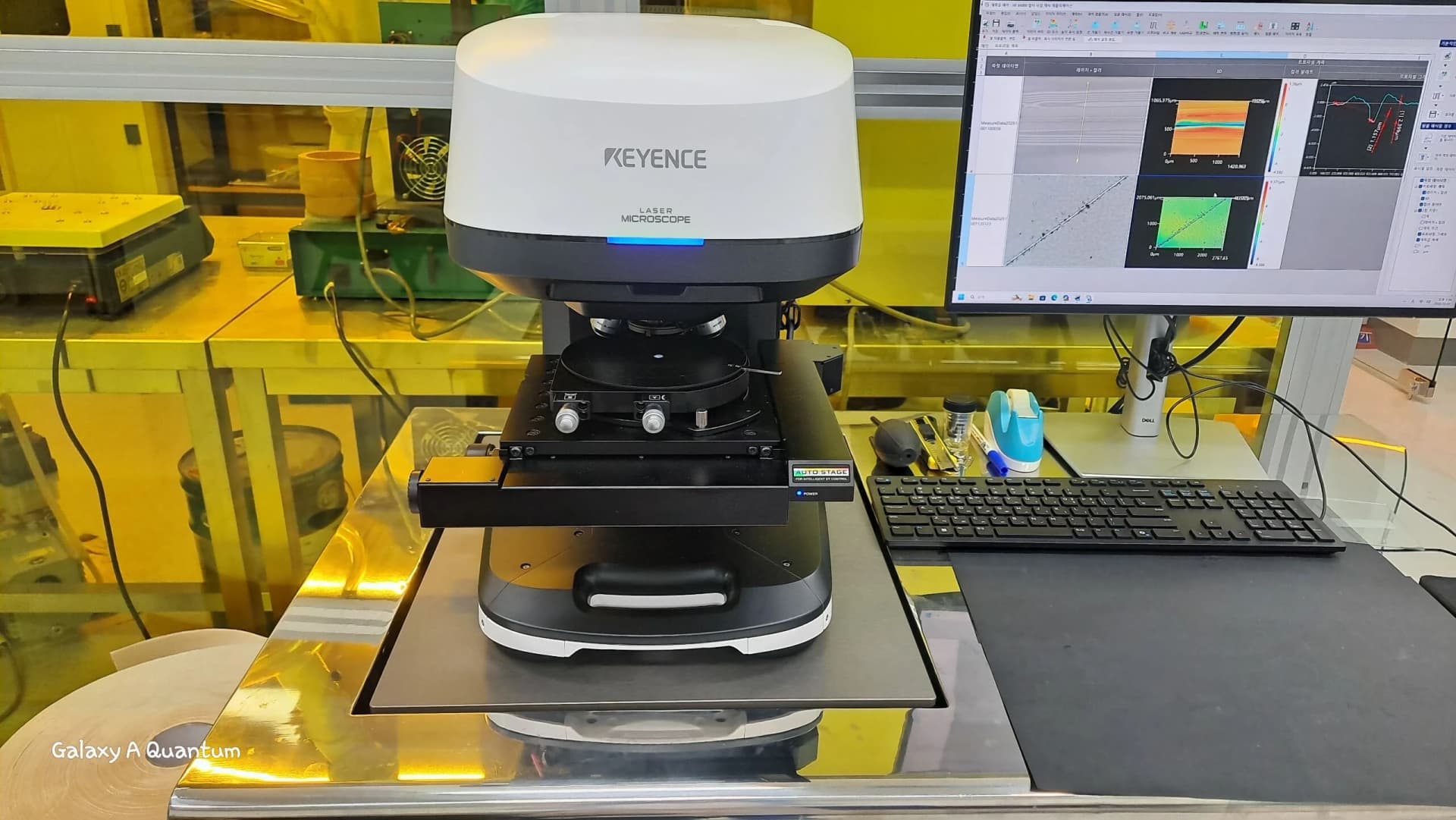
KimTechnix Keyence VK-X4000 Laser Scanning Confocal Microscope DVIA-TD45 (260616R5) Installation Report
Installation report for the DVIA-TD45 (serial 260616R5) installed in the KimTechnix laboratory under a Keyence VK-X4000 laser scanning confocal microscope. Tuning and vibration measurements were performed under three conditions (desk vibration without the isolation platform, passive isolation, and active isolation) with the microscope in the Idle condition, and the final vibration level was measured within the VC-F grade in all axes.

Tier-1 Semiconductor Icheon OLYMPUS Microscope MX63L DVIA-T78 (260819S1) Installation Report
Installation report and demo test for the DVIA-T78 (serial 260819S1) installed in the 1F laboratory of the P&T4 building at a Tier-1 Semiconductor Icheon campus, under an OLYMPUS MX63L microscope. The microscope had no formally defined allowable vibration specification, but image resolution degraded and visible shaking appeared during operation, and the passive isolation table in use was not enough. Two demo tests on the DVIA-T78 and two baseline measurements on the passive table were taken with a B&K Front End Type 3040-A-040 and a PCB 393B05 accelerometer in the IDLE state. On the active platform all three axes settled to the VC-D to VC-E range, and the microscope image shaking and noise disappeared completely. All 24 per-axis Autospectrum and VC Curves plots are published together with the IEST-RP-CC012.2 vibration criteria reference.
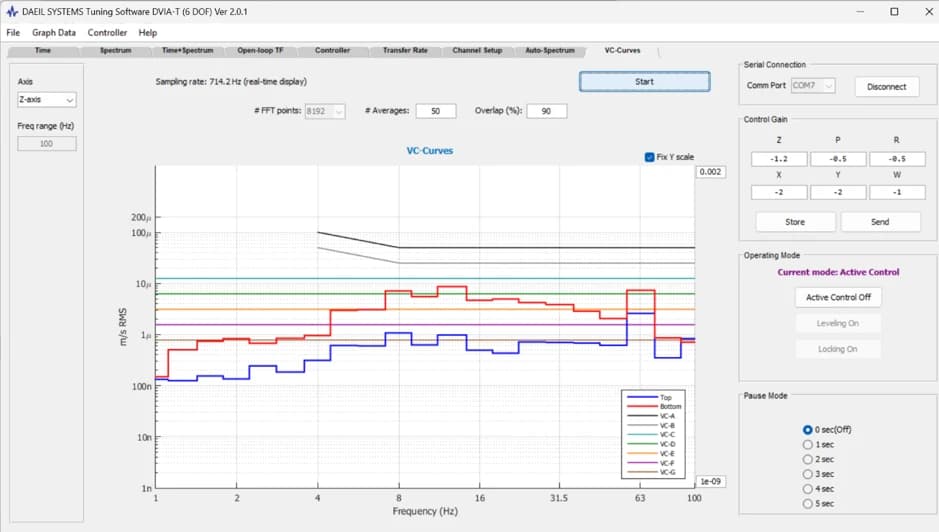
Hyundai Motor Keyence Laser Confocal Microscope VK-3000 DVIA-TD45 Installation Report
Hyundai Motor Environmental Technology Research Center Keyence Laser Confocal Microscope VK-3000 DVIA-TD45 installation report — isolator oscillation diagnosed and re-tuned to meet the VC-C requirement; the DVIA-TD45 platform passes on all axes while floor left-to-right fails, with ventilation-duct airflow noted as an additional influence.
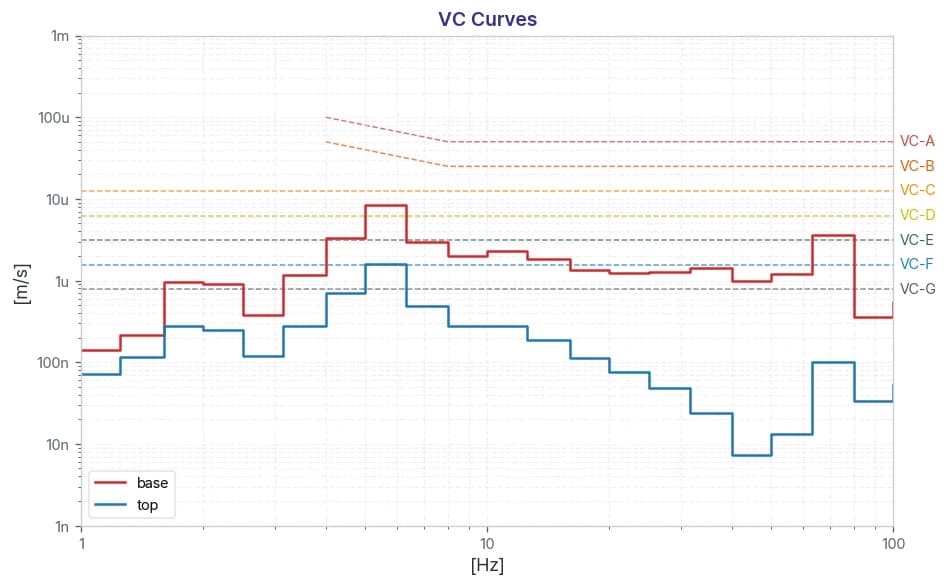
Robocube Tech 6-Axis Actuator DVIA-T87 (260423R2) Installation Report
Installation report for the DVIA-T87 (serial 260423R2) supplied to Robocube Tech. After installation in the Robocube Tech assembly room, tuning and vibration measurement were carried out on 17 June 2026 with the unit in the IDLE state. All three axes — vertical (Z), left to right (X) and front to back (Y) — passed on both the floor and the DVIA-T87 top plate, and vibration on the top plate was confirmed to be attenuated relative to the floor on every axis. Per-axis Autospectrum and VC Curves measured with a B&K Front End Type 3050-A-040 and a PCB 393B05 accelerometer are published together with the IEST-RP-CC012.2 vibration criteria reference.
WONIK IPS DVIA-T78 (211213R1) Installation Report
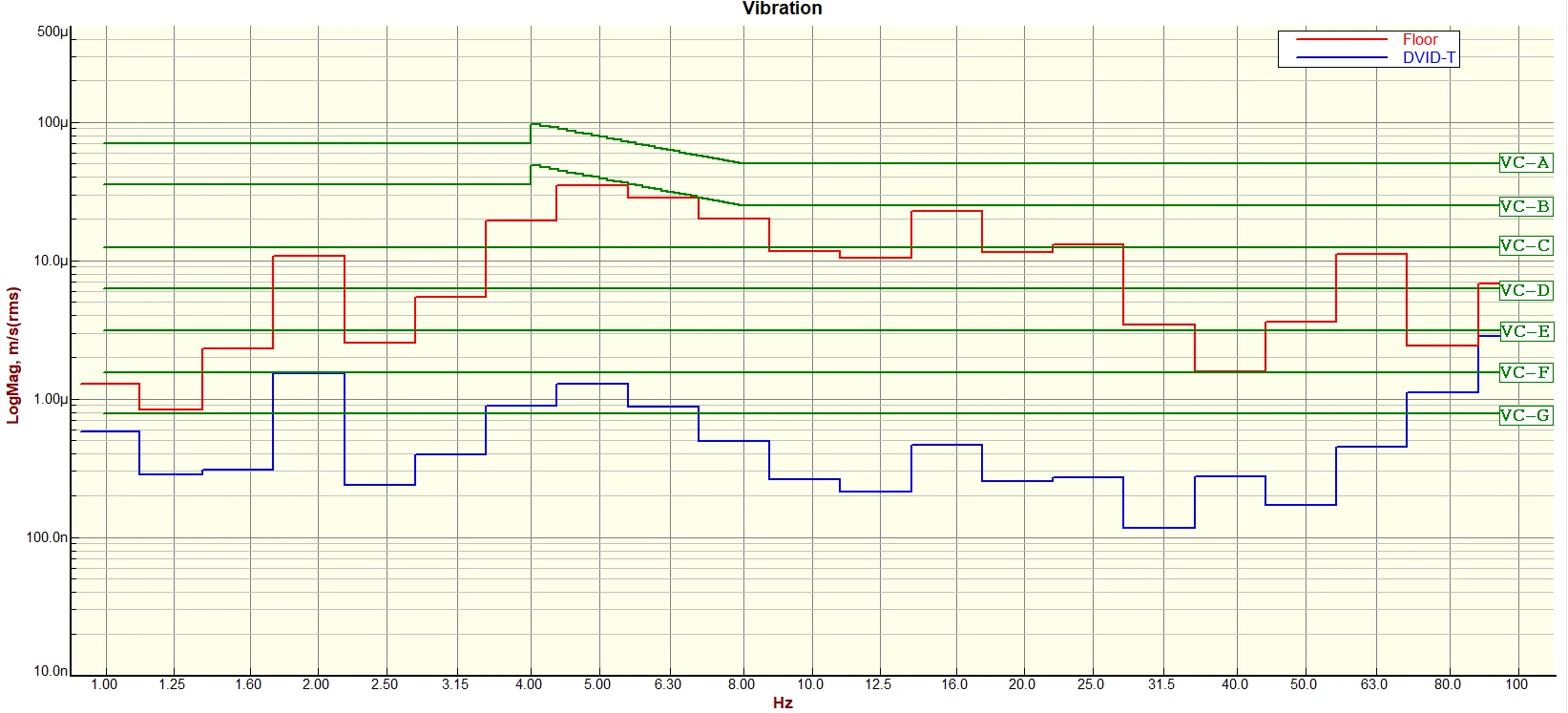
DVIA-T78 (serial 211213R1) installation report for WONIK IPS Jinwi site, 4F wafer analysis lab. Re-tuning and vibration measurement on December 12, 2025, with Bruker Nano Indentation tester TS77 on the isolator. Overview notes a return visit due to high vibration against Bruker self-test criteria; conclusion confirms good isolator performance in all directions while Bruker cited rubber pillars below the tool and planned equipment modification with headquarters. UI plots: VC curves, autospectra, and transmissibility by axis. Reference publishes the standard VC criteria table.
Technical Notes
- Vibration Isolation for AFM: Z-Noise, Site Limits, and Platform Selection
- How to Choose a Vibration Isolation Platform: A Buyer's Guide
- Vibration Isolators: Types, How They Work, and How to Choose
- Benchtop & Tabletop Vibration Isolation: Active Platforms for Bench-Mounted Instruments
- Vibration Isolation for SEM and AFM: Requirements and Solutions
- Faraday Cage Limits in Precision Labs: When Shielding Isn't Enough